
How to Select the Right O-Ring Material for Hydraulic Systems
O-rings are among the most widely used sealing components in hydraulic systems. Their simple design, low cost, easy installation, and reliable sealing performance make them common in hydraulic filters, valve blocks, pumps, motors, cylinders, fittings, and many other components.
However, an O-ring that works perfectly in one hydraulic system may fail quickly in another.
The reason is simple: O-ring performance depends heavily on material selection.
Hydraulic fluid, operating temperature, system pressure, seal movement, and environmental conditions all affect how an elastomer behaves. Selecting the right material is therefore just as important as selecting the correct O-ring size.
This guide looks at five common sealing materials and the key factors to consider when choosing an O-ring for a hydraulic application.
1. NBR — The Standard Choice for Hydraulic Systems
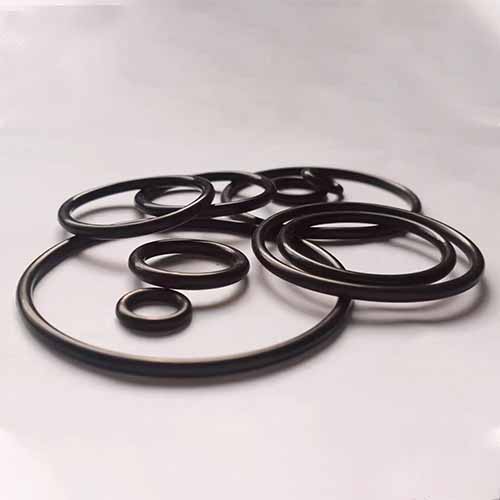
Nitrile Rubber (NBR), also known as Buna-N, is probably the most widely used O-ring material in conventional hydraulic systems.
Its biggest advantage is its excellent compatibility with mineral oil-based hydraulic fluids. NBR also provides good wear resistance, mechanical strength, sealing performance, and relatively low compression set—all at an economical cost.
For typical industrial hydraulic systems using mineral hydraulic oils such as L-HL or L-HM, NBR is often the first material to consider.
Standard NBR compounds typically operate within a temperature range of approximately -30°C to +100°C, although the actual range depends on the specific formulation. Special low-temperature or high-performance compounds can extend these limits.
Where NBR Works Well
NBR is commonly used for static sealing in:
Hydraulic filter housings
Valve blocks and manifolds
Flanges and fittings
Pumps and motors
End covers and plugs
It can also be used in suitable low-speed reciprocating applications.
Where NBR Has Limitations
NBR is not ideal for very high temperatures, prolonged ozone exposure, or certain aggressive chemicals and specialized hydraulic fluids.
At elevated temperatures, NBR can gradually harden, lose elasticity, and develop excessive compression set.
So while NBR is an excellent general-purpose hydraulic sealing material, it should not automatically be used with every hydraulic fluid.
2. FKM — For Higher Temperatures and Demanding Fluids
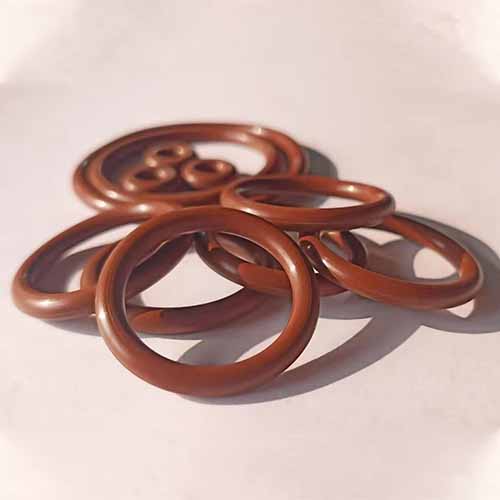
Fluoroelastomer (FKM), widely known through trade names such as Viton, is another important sealing material in hydraulic systems.
Compared with standard NBR, FKM offers significantly better high-temperature resistance, chemical stability, ozone resistance, and aging resistance.
Depending on the specific compound, FKM can typically operate continuously at temperatures approaching 200°C, making it suitable for hydraulic equipment exposed to substantial heat.
It also performs well with many petroleum-based oils, synthetic lubricants, fuels, and industrial chemicals.
Where FKM Works Well
FKM is often selected for:
High-temperature hydraulic systems
Equipment near engines or other heat sources
Long-life sealing applications
Systems exposed to aggressive fluids
Critical equipment where reliability is especially important
For these applications, the higher initial cost of FKM may be justified by longer service life and greater operating reliability.
What About Low Temperatures?
This is one area where standard FKM may not perform as well as NBR.
Conventional FKM becomes harder and less flexible at low temperatures, although special low-temperature FKM compounds are available.
Therefore, simply upgrading from NBR to FKM does not automatically produce a better seal. The complete operating temperature range must be considered.
3. EPDM — An Important Choice for Water-Based Fluids
EPDM (Ethylene Propylene Diene Monomer) has a very different compatibility profile from NBR and FKM.
Its key strengths are excellent resistance to water, hot water, steam, weathering, and ozone. This makes EPDM particularly useful in certain water-based hydraulic and industrial fluid applications.
Depending on the compound, EPDM can typically operate from around -40°C to +150°C and maintains good flexibility at relatively low temperatures.
Where EPDM Works Well
EPDM is commonly considered for compatible:
Water-glycol hydraulic fluids
Water-based fire-resistant fluids
Hot-water applications
Outdoor equipment exposed to weather and ozone
One Critical Limitation
There is one rule that should always be remembered:
EPDM is generally not compatible with mineral oils and petroleum-based greases.
Exposure to incompatible hydrocarbon oils can cause the material to swell, soften, and lose mechanical strength.
This makes fluid identification especially important before selecting EPDM.
4. CR — Useful, but Less Common in Modern Hydraulic Sealing
Chloroprene Rubber (CR), commonly known as Neoprene, offers good weather, ozone, and flame resistance together with moderate oil resistance.
Its outdoor aging performance is generally better than standard NBR, and some formulations also provide good low-temperature flexibility.
However, CR does not normally provide the same mineral-oil resistance as NBR, especially at elevated temperatures.
As a result, it is less commonly chosen as the primary O-ring material in modern hydraulic systems.
CR may still be useful for certain:
Auxiliary static seals
Outdoor applications
Low-demand hydraulic connections
Applications requiring additional ozone or flame resistance
For many hydraulic applications, however, NBR, FKM, or EPDM provides a more clearly defined performance advantage.
How to Choose the Right O-Ring Material
Knowing the characteristics of NBR, FKM, EPDM, CR is only the first step.
The correct O-ring should be selected according to the actual operating conditions of the hydraulic system.
Here are the most important factors.
1. Start with Fluid Compatibility
This should always come first.
The selected elastomer must remain chemically stable when exposed to the hydraulic fluid and its additives.
An incompatible O-ring may:
Swell
Shrink
Soften
Harden
Become brittle
Lose elasticity
Lose mechanical strength
Eventually, these changes can lead to leakage or complete seal failure.
For conventional mineral oil-based hydraulic systems, NBR is often the most economical starting point.
For higher temperatures or demanding fluids, FKM may be more appropriate.
For compatible water-based hydraulic fluids, EPDM may be a better solution.
However, these are only general guidelines. Always verify compatibility with the exact fluid formulation and specific elastomer compound.
2. Consider the Entire Temperature Range
Don't select an O-ring based only on the system's normal oil temperature.
Consider:
Cold start → Normal operation → Peak load → Shutdown → Ambient conditions
At low temperatures, an elastomer can become hard and lose flexibility, increasing the risk of leakage during startup.
At excessive temperatures, the material can age rapidly, harden, crack, or develop permanent compression set.
Local temperatures around pumps, motors, valves, and throttling points can also be considerably higher than the average reservoir oil temperature.
The O-ring therefore needs sufficient temperature margin for the real application.
3. Pressure Is More Than a Material Question
High hydraulic pressure increases the risk of the O-ring being pushed into the clearance between mating components—a failure mechanism known as extrusion.
Material hardness helps, but pressure capability is not determined by the O-ring material alone.
Other important factors include:
Extrusion gap
Groove design
O-ring hardness
Temperature
Pressure cycling
Static or dynamic operation
In high-pressure applications, a backup ring is often installed beside the O-ring to prevent extrusion.
This is why simply switching from NBR to a harder or more expensive material is not necessarily the correct solution to a high-pressure sealing problem.
4. Static or Dynamic Application?
O-rings are particularly effective for static sealing.
Typical examples include hydraulic filter housings, valve blocks, manifolds, fittings, flanges, and end covers.
Dynamic applications are more demanding.
For reciprocating or rotating movement, additional factors become important:
Friction + Wear Resistance + Lubrication + Surface Finish + Hardness + Extrusion Clearance
In demanding dynamic hydraulic applications, a dedicated rod seal, piston seal, or other specialized sealing profile may provide better performance than a conventional O-ring.
5. Think About Service Life, Not Just Purchase Price
For a standard mineral-oil hydraulic system operating under moderate conditions, NBR often offers excellent value.
But the cheapest O-ring is not always the most economical solution.
If the equipment operates at high temperatures, is difficult to maintain, or has a high cost of downtime, a higher-performance material may offer a lower total lifecycle cost.
The real question is not:
Which O-ring is cheaper?
It is:
Which material can provide reliable sealing throughout the required service life?
A Simple O-Ring Material Selection Guide
Here is a material comparison of different materials.
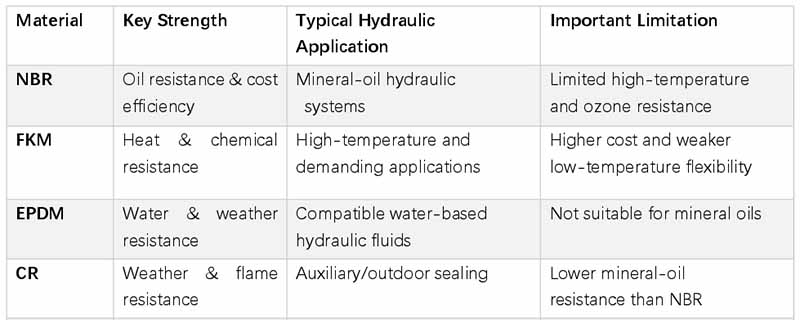
This table should be used as a starting point rather than a final material specification. Different compounds within the same elastomer family can perform very differently.
The Right Material Depends on the Application
There is no universally “best” O-ring material for every hydraulic system.
A practical selection should consider:
Fluid Compatibility + Temperature + Pressure + Motion + Environment + Required Service Life
For many conventional mineral-oil hydraulic systems, NBR remains the standard and most economical choice.
When higher temperatures, aggressive fluids, longer service intervals, or greater reliability are required, FKM or another application-specific material may be more appropriate.
For compatible water-based fluids, EPDM becomes an important option, while polyurethane is particularly valuable for hydraulic sealing applications requiring high wear and extrusion resistance.
Most importantly, don't select an O-ring based only on the generic material name. Always verify the specific compound against the actual hydraulic fluid and operating conditions, and follow established O-ring and groove design standards such as ISO 3601.
Need Help with Hydraulic Filtration?
O-rings may be small components, but their material selection can directly affect the reliability of hydraulic filters and hydraulic systems.
At FiltraMate, we manufacture replacement and customized hydraulic filter elements for a wide range of industrial applications, with different filter media, filtration ratings, and sealing materials available according to operating conditions.
🤝 If you need hydraulic filter elements or technical support for a filtration application, feel free to connect with FiltraMate.