
Oil Reservoir Breathers: A Small Component with a Big Role in Contamination Control
When we talk about oil cleanliness in hydraulic or lubricant system, filters are usually the first components that come to mind. They remove contaminants from the oil and help protect pumps, valves, and other hydraulic components.
But there is another small component that is often overlooked: the hydraulic reservoir breather.
Although it may look like a simple cap on top of an oil tank, a reservoir breather plays an important role in preventing airborne contamination from entering the hydraulic system.
While hydraulic oil filters remove contaminants already present in the oil, reservoir breathers help keep contaminants out in the first place.
Let's take a closer look at how they work and why they matter.
1. Why Do Hydraulic Reservoirs Need to Breathe?
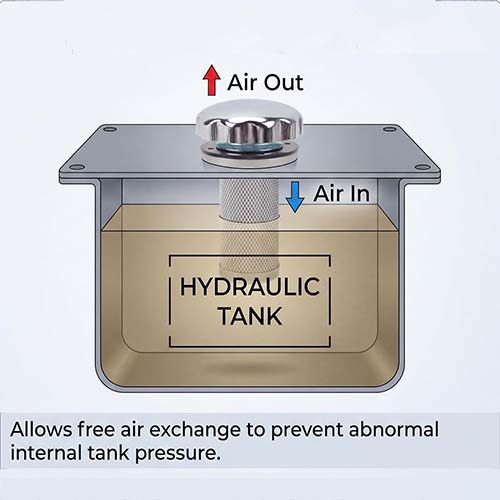
Hydraulic reservoirs are not completely sealed. In hydraulic systems, air needs to move in and out of the reservoir as the equipment operates to maintain pressure balance between the inside of the reservoir and the outside atmosphere.
For example, when a hydraulic cylinder extends, oil may flow from the reservoir into the hydraulic circuit. As the oil level in the reservoir drops, air enters to fill the space.
When the cylinder retracts and oil returns to the reservoir, the air may be pushed back out.
Changes in oil temperature and ambient temperature can also cause air to move in or out of the reservoir.
This movement of air is commonly called reservoir breathing.
The problem is that the incoming air may contain dust, moisture, and other airborne contaminants.
Without proper protection, these contaminants can enter the reservoir and gradually affect hydraulic oil cleanliness.
This is where reservoir breathers come into play.
2. How Does Airborne Contamination Affect Hydraulic Oil?
Air entering a hydraulic reservoir can introduce two common types of contamination: solid particles and moisture. Studies show that at least half of lubricant contamination comes from outside machinery and most machines are designed to "breathe," it's a good idea to stop these contaminants at the source.
Particle Contamination
Dust and fine particles are present in almost every industrial environment, especially in manufacturing plants, mining operations, cement factories, and other dusty workplaces.
When these particles enter the reservoir, they can circulate with the hydraulic oil and contribute to wear in pumps, valves, and other components.
Over time, this can increase filter loading and reduce system reliability.
For more information about particle contamination and hydraulic filter selection, see our previous article: Hydraulic System Contamination: How to Control It and Select the Right Filter.
Moisture Contamination
Air naturally contains moisture.
When humid air enters the reservoir, temperature changes may cause some of that moisture to condense into water.
Moisture contamination can affect oil viscosity, accelerate additive depletion, and contribute to sludge formation. It also cause corrosion, which generates rust particles and leads to further particulate contamination.
Unlike visible dust, moisture contamination may develop gradually without obvious warning signs.
We discussed this subject in more detail in our article: Water Contamination in Hydraulic Oil: Causes, Effects, Detection and Removal.
A suitable reservoir breather can help reduce the entry of these contaminants before they reach the hydraulic oil.
3. Common Types of Hydraulic Reservoir Breathers
Not all reservoir breathers provide the same level of protection.
Depending on their design and filtration materials, they may offer different levels of particle and moisture control.
Here are three common types.
3.1 Traditional Filler / Breather Caps
Traditional filler/breather caps are among the simplest and most commonly used designs.
They are usually installed directly on top of the hydraulic reservoir and may use metal mesh, foam, or other basic filtration materials.
Their main advantages include:
Simple construction
Low cost
Easy installation and replacement
Basic protection against larger debris
However, these breathers may provide limited protection against fine airborne particles.
They also generally do not remove moisture from incoming air.
For relatively simple hydraulic systems operating in clean environments, traditional breathers may be sufficient. But in dusty or humid environments, better protection may be needed.
3.2 High-Efficiency Particle Breathers
High-efficiency particle breathers are designed to provide better protection against airborne dust.
Unlike basic mesh-type breathers, they use finer filtration media to capture smaller particles before the air enters the reservoir.
Their main benefits include:
Better removal of airborne particles
Reduced dust entering the hydraulic reservoir
Improved protection for contamination-sensitive systems
Helping maintain hydraulic oil cleanliness
These breathers can be particularly useful in industrial environments where airborne dust is a common problem.
However, their primary function is particle filtration. They do not necessarily provide effective moisture removal.
3.3 Desiccant Breathers
Desiccant breathers are multi-tiered devices installed on your machines to prevent the entry of both airborne particles and moisture. They typically combine particle filtration media with a moisture-absorbing material known as a desiccant.
As air enters the reservoir, the filtration media captures airborne particles while the desiccant absorbs moisture from the incoming air.
Many desiccant breathers use silica gel or similar moisture-absorbing materials.
Some designs have transparent housings or color-changing desiccants, allowing maintenance personnel to check the condition of the moisture-absorbing material.
Their main advantages include:
Reducing airborne particle ingress
Reducing moisture entering the reservoir
Helping protect hydraulic oil in humid environments
Supporting long-term oil cleanliness management
Desiccant breathers are particularly useful for hydraulic systems operating in humid environments or applications where water contamination is a concern.
However, the desiccant has a limited moisture-absorbing capacity and must be replaced when exhausted.
4. When Should You Consider Upgrading a Reservoir Breather?
Not every hydraulic system needs the most advanced breather.
The appropriate choice depends on the operating environment, system sensitivity, and contamination-control requirements.
You may want to consider upgrading the existing reservoir breather if:
The equipment operates in a dusty environment. Airborne particles can enter the reservoir during normal breathing.
The factory has high humidity or frequent temperature changes. These conditions can increase the risk of moisture entering the oil.
Water contamination repeatedly appears in the hydraulic oil. A suitable desiccant breather may help reduce moisture ingress through reservoir breathing.
The system uses contamination-sensitive components. Servo valves and other precision hydraulic components may require stricter contamination control.
The existing breather uses only basic mesh or foam. A higher-efficiency breather may provide better protection against fine particles.
It is important to understand that a reservoir breather is a preventive component, not an oil purification device.
It helps reduce contamination entering through the reservoir's air exchange, but it cannot remove particles or water already circulating in the hydraulic oil.
Therefore, reservoir breathers and hydraulic oil filters should work together as part of the overall contamination-control strategy.
5. Simple Maintenance Tips for Reservoir Breathers
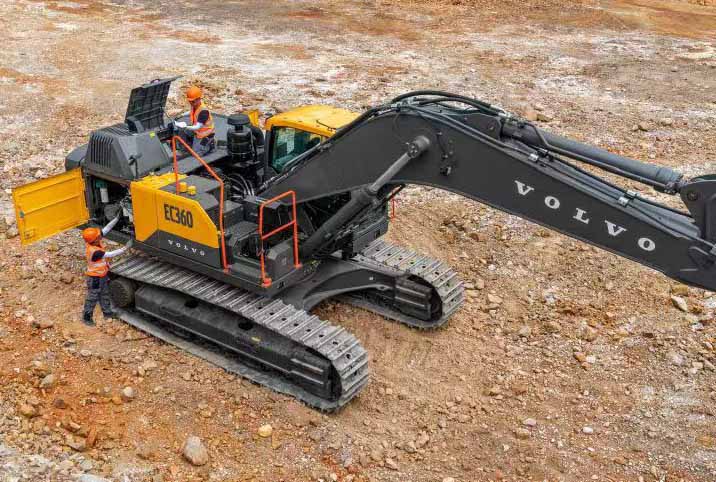
Like other filtration components, reservoir breathers require regular inspection and maintenance. A clogged breather can cause vacuum or pressure buildup inside the reservoir, potentially leading to pump cavitation, abnormal equipment operation, or even tank damage and oil leakage.
A few simple practices can help keep them working effectively:
Inspect regularly. Check for dust accumulation, physical damage, or blocked air passages.
Replace clogged elements. A heavily contaminated breather may restrict airflow and no longer provide effective protection.
Check desiccant condition. For breathers with color-changing desiccants, follow the manufacturer's instructions to determine when replacement is needed.
Keep reservoir openings protected. Make sure breathers are properly installed and reservoir openings remain sealed against contamination.
Follow replacement recommendations. Service life depends on environmental conditions, operating frequency, and breather design.
Regular inspection can help ensure that this small component continues to protect the hydraulic system.
Hydraulic oil cleanliness is not only about removing contamination after it enters the system. Preventing contamination from entering the reservoir is equally important.
At FiltraMate, we provide replacement hydraulic and lubrication oil filter elements and offline filtration solutions to help maintain oil cleanliness in industrial equipment.
If you have any questions about hydraulic oil filtration, replacement filter elements, or contamination control, feel free to connect with FiltraMate to discuss your application.