
Water Contamination in Hydraulic Oil: Causes, Effects, Detection and Removal
When we talk about hydraulic oil cleanliness, particle contamination often gets most of the attention. But particles are only part of the problem.
Water is another major contaminant that can affect hydraulic system reliability.
And unlike visible dirt, water contamination is not always easy to recognize. Hydraulic oil may look perfectly clear and still contain a significant amount of dissolved moisture.
Water can enter a hydraulic system through humid air, condensation, leaking heat exchangers, improper oil storage, equipment washing, and maintenance activities. Once inside the oil, it can contribute to corrosion, oil degradation, deposits, and component damage.
So where does water come from? How does it exist in hydraulic oil? How can we detect it—and, most importantly, how can we remove and control it?
Let's take a closer look.
1. Where Does Water Enter a Hydraulic System?
Water contamination does not always mean that there is a major leak somewhere in the system.
In many hydraulic systems, small amounts of moisture can enter continuously during normal operation.
Common sources include:
Condensation caused by changes in temperature
Humid air entering through reservoir breathers
Cooler or heat-exchanger leakage
Equipment washing and high-pressure cleaning
Improper storage of new or used oil
Open reservoir ports during inspection or maintenance
Contaminated oil-transfer equipment
Water already present in new or stored hydraulic oil
Reservoir breathing is an important example.
As the oil level rises and falls, and as oil and ambient temperatures change, air moves in and out of the reservoir. If humid air enters the reservoir and later cools, moisture may condense inside the tank.
This means water contamination can develop gradually even when there is no obvious water leak.
Keeping water out of a hydraulic system starts with understanding how it gets in.
2. The Three Forms of Water in Hydraulic Oil
Water in hydraulic oil does not always look the same.
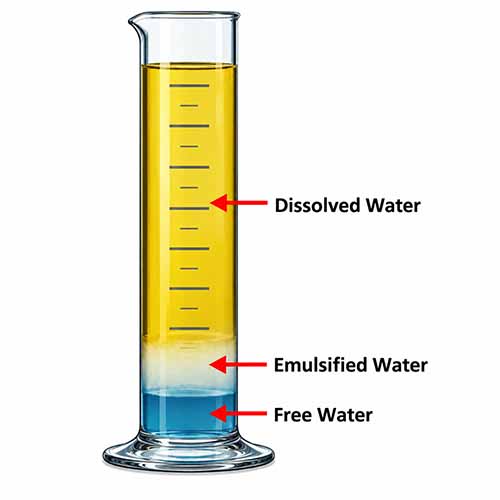
Depending on the amount of water, oil type, temperature, and other conditions, water can generally exist in three forms:
Dissolved Water
At relatively low concentrations, water molecules can remain dissolved in the oil.
The oil may still look clear, making this form of contamination difficult to detect by visual inspection.
The amount of dissolved water an oil can hold depends on several factors, including:
Oil type
Additive chemistry
Oil condition and age
Temperature
This is why clear oil should not automatically be assumed to be dry oil.
Emulsified Water
As water concentration increases beyond what the oil can keep dissolved under the existing conditions, very small water droplets may become suspended throughout the oil.
This is known as emulsified water.
The oil may begin to appear cloudy or milky.
At this stage, water becomes more problematic because it is no longer completely dissolved in the oil and can contribute more directly to lubrication and reliability problems.
Free Water
When water separates from the oil, it becomes free water.
Free water may settle at the bottom of the reservoir or appear as visible droplets or a separate water layer.
If free water can be seen in a hydraulic reservoir, the system has a water-contamination problem that should be investigated.
The progression can be summarized simply as:
Dissolved Water → Emulsified Water → Free Water
However, the relationship between these forms is strongly influenced by temperature and oil chemistry.
3. Water Saturation: Why Temperature Matters
Every hydraulic oil has a limit to how much water it can hold in a dissolved state.
This limit is commonly referred to as the water saturation point.
Once the oil approaches or exceeds saturation, additional water can begin to appear as emulsified or free water.
But there is no single saturation value that applies to every hydraulic oil.
Water saturation depends on factors such as:
Base oil type
Additive package
Oil age and degradation
Operating temperature
Temperature is particularly important.
In general, warmer oil can hold more dissolved water than the same oil at a lower temperature.
This creates an interesting situation:
Oil may appear clear while the machine is operating at a higher temperature, but as the oil cools, some of the dissolved water may come out of solution.
For this reason, simply measuring water concentration without considering oil condition and temperature may not tell the complete story.
Some conventional hydraulic oils may have relatively low water saturation limits, but the actual value should be determined from the specific oil and operating conditions rather than applying one universal ppm or percentage limit to every system.
4. What Does Water Do to a Hydraulic System?
Water can affect both the hydraulic components and the oil itself.
Corrosion and Rust
One of the most obvious effects is corrosion.
When water contacts iron or steel surfaces, rust can form. This creates two problems at the same time.
First, corrosion can damage components, reservoirs, and piping.
Second, corrosion itself generates solid contamination.
The result can become a contamination cycle:
Water → Corrosion → Rust Particles → Additional Particle Contamination
The system is no longer dealing only with water—it now also has additional solid particles circulating in the oil.
Pump Damage and Cavitation-Related Problems
Conditions at the suction side of a hydraulic pump can involve relatively low pressure.
Under unfavorable combinations of pressure, temperature, water contamination, and other operating conditions, vapor bubbles can form. When these bubbles move into higher-pressure regions and collapse, the resulting localized forces can damage component surfaces.
Cavitation is a complex phenomenon and should not automatically be attributed to water contamination alone. Pump inlet restrictions, oil viscosity, temperature, aeration, and system design can also play important roles.
Nevertheless, excessive water contamination can contribute to operating conditions that are harmful to pumps and other hydraulic components.
Oil and Additive Degradation
Water can also affect the hydraulic fluid itself.
Depending on the oil formulation and operating conditions, water may contribute to:
Oxidation and degradation
Additive depletion or instability
Formation of sludge
Formation of soft deposits
Reduced lubricant performance
These changes can gradually affect both oil life and system cleanliness.
Sludge, Resin and Varnish
Oil degradation products deserve particular attention in systems with small clearances, such as servo and proportional valve applications.
Soft or sticky deposits can accumulate on valve surfaces and in narrow clearances. These deposits can also capture fine particles that might otherwise pass through the clearance.
This can create another damaging cycle:
Water → Oil Degradation → Sludge / Varnish → Particle Trapping → Valve Problems
For this reason, water control is not simply about preventing rust. It is also part of maintaining the overall condition and cleanliness of the hydraulic oil.
5. How Do You Know If There Is Too Much Water?
Some forms of water contamination are easy to see. Others are not.
Visual Inspection
Visual inspection can identify obvious problems such as:
Cloudy oil
Milky oil
Visible water droplets
Free water at the bottom of the reservoir
However, visual inspection has an important limitation:
Dissolved water cannot normally be identified just by looking at the oil.
By the time oil becomes visibly cloudy or free water appears, the water concentration may already have exceeded the oil's saturation level under those conditions.
Karl Fischer Water Testing
For more accurate measurement, Karl Fischer titration is widely used to determine water content in oil.
ASTM D6304 is one commonly referenced test method for determining water in petroleum products, lubricating oils, and additives.
Results may be expressed in ppm or as a percentage by mass.
This provides much more useful information than visual inspection alone.
Relative Saturation
Another useful approach is to monitor relative water saturation, often expressed as a percentage of saturation.
This helps answer a different question from ppm:
How close is the oil to the amount of water it can hold under the current conditions?
For example, the same absolute water concentration can represent very different conditions depending on the oil type and temperature.
For routine condition monitoring, both absolute water content and saturation information can be valuable, depending on the application and measurement method.
6. How Can Water Be Removed from Hydraulic Oil?
There is no single water-removal technology that is ideal for every hydraulic system.
The appropriate method depends on:
Whether the water is dissolved, emulsified, or free
The amount of water present
Oil viscosity
Oil chemistry and demulsibility
Required final water level
System size and operating conditions
Several technologies are commonly used.
Water-Absorbing Filter Elements
Water-absorbing elements use absorbent media or polymers that capture and retain water.
They can be useful where relatively small quantities of free water need to be removed.
In some filtration systems, water removal and particle filtration can be combined.
However, absorbent elements have a finite water-holding capacity and are generally not the best solution for removing large quantities of water or deeply dissolved moisture.
The type of water present should therefore be considered before selecting this technology.
Coalescing and Water Separation
Where the oil has good water-separation characteristics, coalescing technology can be used to separate dispersed water from oil.
The basic process is:
Small Water Droplets → Coalescence → Larger Droplets → Separation
As small droplets combine into larger ones, they become easier to separate from the oil.
Performance depends strongly on fluid properties, viscosity, temperature, and the oil's ability to release water.
Vacuum Dehydration
For more severe water contamination or applications requiring deeper dehydration, vacuum dehydration can be an effective solution.
By reducing pressure and controlling temperature, vacuum dehydration systems can facilitate the removal of:
Free water
Emulsified water
Dissolved water
They are commonly used where water contamination is significant or where very low moisture levels are required.
Offline Fine Filtration
Offline—or kidney-loop—filtration provides another approach to oil cleanliness management.
Instead of relying only on filtration in the main hydraulic circuit, an offline unit continuously draws oil from the reservoir, treats it, and returns it to the tank.
Depending on the filter technology and media used, offline filtration can help address:
Fine particles
Water contamination
Sludge
Resin
Varnish and other oil-degradation products
This can be particularly useful for systems that require continuous oil conditioning.
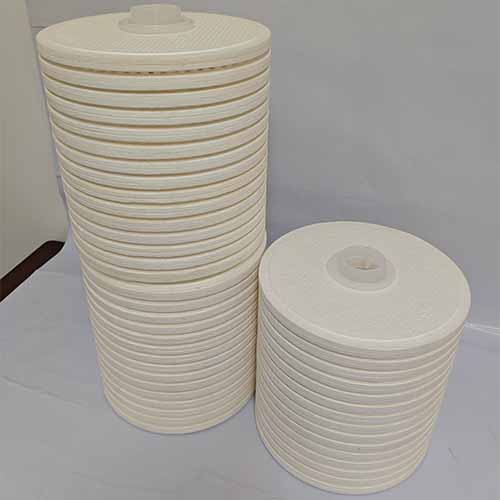
FiltraMate CJC-compatible alternative filter inserts, for example, are designed for offline oil filtration applications where particle, water, and oil-degradation contamination need to be controlled. The actual water-removal capability depends on the insert type, oil properties, operating conditions, and the form of water present.
The important point is to match the water-removal technology to the contamination problem, rather than simply adding another filter and expecting it to solve every type of water contamination.
Keep Hydraulic Oil Clean—and Dry
Hydraulic oil cleanliness is not only about controlling particles.
Water can enter a hydraulic system gradually, exist in forms that cannot be seen, contribute to corrosion and oil degradation, and create additional contamination problems throughout the system.
Effective water control starts with understanding where the water comes from, what form it is in, how much is present, and which removal technology is appropriate for the application.
At FiltraMate, we provide replacement hydraulic and lubrication oil filter elements, offline oil filtration solutions, and CJC-compatible alternative filter inserts for oil cleanliness management.
If you are dealing with water contamination, particle contamination, oil degradation, or hydraulic filtration problems, feel free to connect with FiltraMate to discuss your application.