
The Global Filtration Industry Map: Where the Major Brands Come From
1. A Global Industry with Regional Roots
Industrial filtration is a global business. Filters and filtration systems are used everywhere—from hydraulic machinery and power plants to steel mills, mining equipment, marine applications, chemical processing, and manufacturing.
Yet when we look at many of the industry's established brands, an interesting pattern appears: a significant number originated from a relatively small group of industrial regions.
The United States is home to names such as Pall, Parker Hannifin, Eaton, Donaldson, Schroeder, and Hy-Pro. Germany has produced HYDAC, STAUFF, ARGO-HYTOS, Hengst, and several important filtration businesses that have changed ownership over time. Italy has developed a strong group of hydraulic filtration specialists, including MP Filtri, Filtrec, and UFI/Sofima. Japan has its own long-established filtration manufacturers, while Northern Europe has become particularly notable for companies focused on continuous oil conditioning.
Why have these regions produced so many influential filtration companies?
The answer is closely connected to their industrial history, engineering strengths, manufacturing ecosystems, and the industries they serve.
2. United States — Scale, Diversification and Industrial Reach
The United States has one of the broadest and most diversified filtration industries in the world.
Well-known names include Pall, Parker Hannifin, Eaton, Donaldson, Schroeder Industries, and Hy-Pro Filtration. Some began with a relatively focused filtration or fluid-power business and later expanded into much larger product portfolios and global markets.
A defining characteristic of the U.S. filtration industry is scale.
Many American filtration companies serve multiple sectors rather than concentrating on one narrow application. Their technologies can be found across hydraulics, aerospace, power generation, heavy equipment, oil and gas, process industries, manufacturing, and life sciences.
Another important feature is the role of industry consolidation.
Over the years, acquisitions have brought many filtration technologies under larger industrial groups. Internormen became part of Eaton, domnick hunter joined Parker Hannifin, Filter Specialists (FSI) was acquired by Pall, and Pall itself was later acquired by Danaher.
These transactions did more than change ownership. They helped create broader filtration portfolios, stronger global distribution networks, and companies capable of serving customers across multiple industries and regions.
The U.S. filtration industry is therefore characterized by scale, broad industrial coverage, and strong integration with larger industrial technology groups.
3. Germany — Engineering-Driven Hydraulic Filtration
If the United States represents scale and diversification, Germany is closely associated with engineering-driven hydraulic and industrial filtration.
Germany's filtration industry developed alongside its strong foundations in mechanical engineering, hydraulics, machine tools, automotive manufacturing, mobile equipment, and industrial machinery.
Companies such as HYDAC, STAUFF, and ARGO-HYTOS reflect this close relationship between filtration and fluid-power engineering.
For many German manufacturers, filtration is not an isolated component. Filter elements and housings are often part of a broader product ecosystem involving hydraulic accessories, fluid conditioning, contamination monitoring, sensors, and complete fluid-management solutions.
Germany also provides some interesting examples of how engineering heritage can continue even when ownership changes.
One notable development is the filtration business historically associated with EPE (K. & H. Eppensteiner). The business became part of Bosch Rexroth and its hydraulic filtration activities were later acquired by Hengst, another German filtration group.
A similar transition occurred with MAHLE Industrial Filtration. In 2016, MAHLE sold its Industrial Filtration business to the U.S.-based Filtration Group, and the business subsequently became part of Filtration Group Industrial.
These developments illustrate an important characteristic of the filtration industry: company names and ownership may change, but engineering knowledge, products, manufacturing capabilities, and market experience often continue under new organizations.
Germany's strength in filtration therefore comes not only from established brands, but also from a deep engineering heritage closely connected to hydraulics and mechanical engineering.
4. Italy — A Strong Cluster of Hydraulic Filtration Specialists
Italy represents another interesting model.
Unlike the United States, where several major filtration businesses belong to large diversified industrial corporations, Italy has developed a strong ecosystem of specialized hydraulic filtration manufacturers.
Companies such as MP Filtri, Filtrec, and UFI/Sofima have built significant international businesses around filtration, fluid power, and related industrial applications.
This specialization reflects Italy's broader strength in hydraulic components, mobile machinery, agricultural equipment, industrial machinery, and OEM manufacturing.
Italian filtration companies are particularly visible in products and markets associated with hydraulic filters, filter elements, accessories, contamination control, and OEM equipment.
Many of these companies have also developed extensive international distribution networks, allowing specialized manufacturers from Italy to compete in markets far beyond Europe.
This makes Italy an important filtration manufacturing cluster in its own right.
Rather than being defined primarily by industrial scale, Italy's filtration industry is distinguished by specialization, manufacturing expertise, and strong connections with the global fluid-power market.
5. Japan — Reliability and Industrial Manufacturing
Japan's filtration industry developed within one of the world's strongest manufacturing economies.
Companies such as Taisei Kogyo have long been associated with hydraulic and industrial filtration, serving applications connected to construction machinery, industrial equipment, hydraulics, and manufacturing.
The development of Japanese filtration companies also reflects the international expansion of Japan's machinery manufacturers.
As Japanese construction equipment, industrial machinery, automotive products, and hydraulic systems entered global markets, their component supply chains—including filtration products—expanded with them.
Compared with some Western filtration groups, Japanese companies may receive less attention in international filtration discussions, but they remain an established part of the industry.
Three characteristics help describe Japan's position on the filtration map:
Reliability. Manufacturing quality. Long-term OEM relationships.
These strengths reflect the broader manufacturing culture from which many Japanese industrial component companies developed.
6. Northern Europe — A Different Filtration Philosophy
Northern Europe presents a somewhat different story.
While many filtration companies in the United States, Germany, and Italy developed around conventional hydraulic and industrial filtration, Northern Europe has produced several specialized companies with a different focus: continuously maintaining oil condition rather than simply protecting individual components.
Companies such as C.C.JENSEN (CJC), GreenOil, and Europafilter are associated with this broader oil-conditioning philosophy.
Instead of focusing only on full-flow filtration within the main hydraulic or lubrication circuit, these companies have built businesses around concepts such as:
Offline Filtration → Oil Cleaning → Oil Conditioning → Oil Life Extension → Equipment Reliability
This approach has found applications in lubrication systems, gearboxes, marine equipment, wind turbines, power generation, hydraulics, and other equipment where maintaining oil condition over long operating periods is important.
The business landscape has also evolved. Europafilter, for example, became part of SKF following its acquisition in 2021, demonstrating once again how specialized filtration technologies can become part of larger industrial groups.
Northern Europe therefore represents a distinctive part of the global filtration map—not necessarily through the largest filtration corporations, but through specialized companies that have helped develop the market for continuous oil conditioning and offline filtration.
7. What the Global Filtration Map Tells Us
Looking across these regions, several different industry patterns become visible:
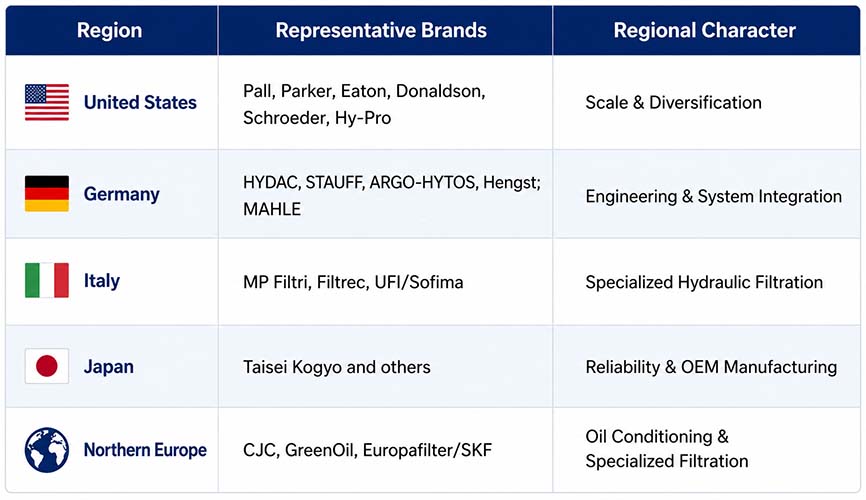
Today, however, these regional boundaries are increasingly blurred. Mergers and acquisitions, global manufacturing, and international supply chains have made filtration a truly global industry. A brand's origin may reflect its engineering heritage, but its business and market reach often extend far beyond national borders.
At FiltraMate, we're also part of this global filtration supply chain, providing alternative hydraulic and lubrication filter elements for internationally recognized brands. If you're looking for reliable replacement filter elements or filtration support, feel free to connect with us.