
Hydraulic System Contamination: How to Control It and Select the Right Filter
Hydraulic systems are at the heart of countless industrial machines—from excavators and mobile equipment to CNC machines, production lines, and other precision systems.
But even a well-designed hydraulic system has one persistent challenge: contamination.
Fine particles, water, and other contaminants can accelerate component wear, affect valve performance, shorten oil life, and eventually lead to unexpected downtime.
That is why hydraulic oil cleanliness is not simply a maintenance issue. It is an important part of equipment reliability.
So, where does contamination come from, and how should we select the right hydraulic filter to control it?
Where Does Hydraulic Contamination Come From?
Hydraulic oil may look clean to the naked eye and still contain harmful contamination.
Contaminants generally come from several sources.
External contamination can enter through reservoir breathers, imperfect seals, maintenance work, oil filling, or exposure to dusty and humid environments.
Internally generated contamination comes from normal wear of pumps, valves, cylinders, bearings, seals, and other components.
Even new hydraulic oil should not automatically be considered clean enough for sensitive hydraulic equipment. Contamination can be introduced during production, transportation, storage, transfer, and filling.
Many of the most damaging particles are measured in microns and cannot be seen without specialized equipment.
Once circulating through the system, these particles can contribute to:
Abrasive wear of pumps and valves
Blockage of small clearances and orifices
Reduced performance of servo and proportional valves
Accelerated seal and component wear
Shorter oil and filter service life
Increased risk of unexpected equipment failure
For this reason, controlling contamination should be a continuous process rather than a one-time maintenance action.
Contamination Control Starts Before the Filter
A good hydraulic filter is essential, but filtration alone cannot solve every contamination problem.
Effective hydraulic contamination control starts by reducing the amount of contamination entering or being generated inside the system.
Good practices include maintaining seals and reservoir breathers, keeping filling and maintenance equipment clean, filtering new oil before or during filling, and preventing unnecessary exposure of hydraulic components to the environment.
For critical systems, regular oil analysis and particle counting can also help determine whether the required cleanliness level is being maintained.
A practical approach is:
Identify the cleanliness requirement → Prevent contamination → Filter effectively → Monitor oil cleanliness
The objective is not simply to install a filter. It is to maintain the oil cleanliness level required by the hydraulic components.
How to Select the Right Hydraulic Filter
Selecting a hydraulic filter involves much more than finding an element that fits the housing. In this article, I also explained the strategy in hydraulic filter selection.
Hydraulic Filter Selection: Finding the Right Balance Between Oil Cleanliness and Cost
Several factors should be considered together.
1. Start with the Required Oil Cleanliness
Different hydraulic components have different contamination sensitivities.
Servo valves and proportional valves, for example, generally require cleaner oil than less sensitive components.
A useful starting point is to define the required ISO 4406 cleanliness level for the system. The filtration system can then be selected to help achieve and maintain that target.
This is a better approach than simply asking:
“Should I use a 5 μm or 10 μm filter?”
The real question is:
“What oil cleanliness level does this hydraulic system need?”
2. Don't Look at Micron Rating Alone
Micron rating tells only part of the story.
Two filter elements both described as "10 μm" may perform very differently.
For hydraulic filter elements, filtration efficiency should preferably be evaluated together with the Beta ratio, typically determined through multi-pass testing such as ISO 16889.
When comparing replacement hydraulic filter elements, consider:
Micron Rating + Beta Ratio + Dirt-Holding Capacity + Pressure Drop + Structural Integrity
These parameters provide a much better picture of actual filter performance than micron rating alone.
3. Match the Filter to the System Pressure
Hydraulic filters operate at very different pressure levels depending on their installation location.
A pressure-line filter may be exposed to very high system pressure, while return-line and offline filters operate under very different conditions.
The filter housing and element construction must therefore be suitable for the maximum operating pressure, pressure fluctuations, and possible pressure surges at the installation point.
Pressure capability should never be assumed simply because two filter elements have similar dimensions.
4. Make Sure the Filter Can Handle the Required Flow
Flow rate has a direct influence on differential pressure (ΔP) across the filter element.
If the filter is undersized, excessive flow can create high pressure drop, reduce system efficiency, and potentially cause the bypass valve to open.
Once bypass occurs, some or all of the oil may circulate without passing through the filter media.
When selecting a filter, consider not only the nominal system flow but also viscosity, cold-start conditions, contamination loading, and expected pressure drop throughout the filter's service life.
5. Consider the Filter Media and Operating Fluid
Different applications may require different filter media.
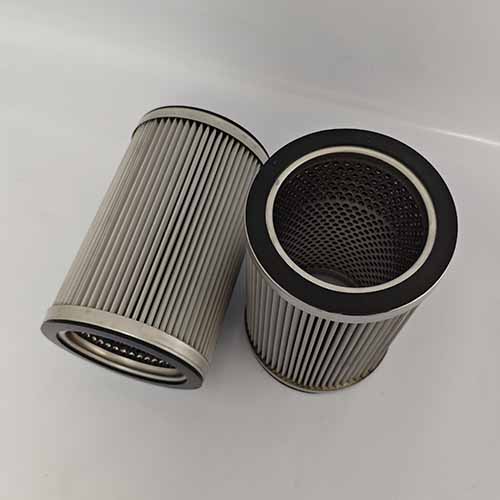
Common options for hydraulic and lubrication filtration include:
Glass fiber
Synthetic media
Cellulose
Stainless steel wire mesh
The appropriate choice depends on filtration efficiency, fluid compatibility, operating temperature, cleanability requirements, pressure conditions, and the application itself.
Seal material also matters. NBR, FKM, and EPDM each have different compatibility characteristics, so the O-ring material should be selected according to the actual hydraulic fluid and operating temperature. In this article, I explained in detail several commonly used O-ring materials in hydraulic system.
How to Select the Right O-Ring Material for Hydraulic Systems
When Should a Hydraulic Filter Element Be Replaced?
A hydraulic filter element should not be replaced based only on how it looks from the outside—or simply because it has been installed for a certain number of months.
As contamination accumulates in the media, the element's differential pressure increases.
Where available, a differential pressure indicator or clogging indicator provides a much more useful reference for determining when the element is approaching its service limit.
Other changes—such as abnormal system pressure, increasing oil temperature, unusual noise, or declining machine performance—may indicate a hydraulic problem, but they should not automatically be treated as proof that the filter element is clogged.
The best approach is to combine:
Differential Pressure + Oil Cleanliness Monitoring + Operating Hours + Equipment Condition
This allows filter replacement to become part of a planned contamination-control strategy rather than a reaction to equipment failure.
Clean Oil Is an Investment in Equipment Reliability
Effective hydraulic filtration is not simply about removing dirt from oil.
It is about maintaining the level of cleanliness required by pumps, valves, cylinders, and other critical components throughout the life of the system.
A good contamination-control strategy starts with the required ISO 4406 cleanliness target, minimizes contamination ingress, uses properly selected hydraulic filter elements, and verifies the result through monitoring.
At FiltraMate, we manufacture replacement hydraulic and lubrication oil filter elements for a wide range of industrial applications. Our focus is on helping filtration companies, distributors, and industrial users find reliable replacement filter solutions based on actual operating requirements.
🤝 If you need hydraulic filter elements or technical support for a filtration application, feel free to connect with FiltraMate.