
Depth Filter vs Surface Filter: Which Filtration Technology Fits Your Application?
In industrial oil filtration, one question comes up repeatedly:
Should I choose a depth filter or a surface filter?
At first glance, the answer may seem straightforward. Many people assume one filtration technology is simply better than the other. In reality, that's not the case.
Depth filters and surface filters are designed to solve different contamination challenges. Each has its own strengths, limitations, and ideal applications. Choosing the right filter depends on factors such as contamination type, required cleanliness level, maintenance strategy, and system design.
Whether you're maintaining hydraulic equipment, lubrication systems, or designing oil filtration solutions, understanding the differences between these two technologies can help you make better filtration decisions and improve overall equipment reliability.
What Is a Depth Filter?
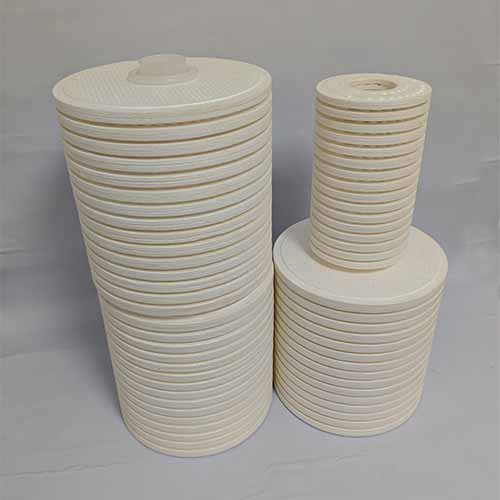
A depth filter captures contaminants throughout the entire thickness of the filter media rather than only on its surface.
As oil flows through multiple layers of porous media, particles of different sizes become trapped at various depths. This three-dimensional filtration structure provides a high dirt-holding capacity while maintaining excellent filtration efficiency for fine contaminants.
Common depth filter media include:
Cellulose
Glass fiber (microglass)
Multi-layer composite media
Because contaminants are distributed throughout the media, depth filters can often operate longer before reaching their maximum differential pressure.
Typical applications include:
Hydraulic systems
Lubrication systems
Offline (kidney-loop) filtration units
Oil conditioning systems
High-efficiency oil cleanliness programs
Depth filtration is widely used where maintaining low particle counts and achieving stringent ISO 4406 cleanliness levels are important.
What Is a Surface Filter?
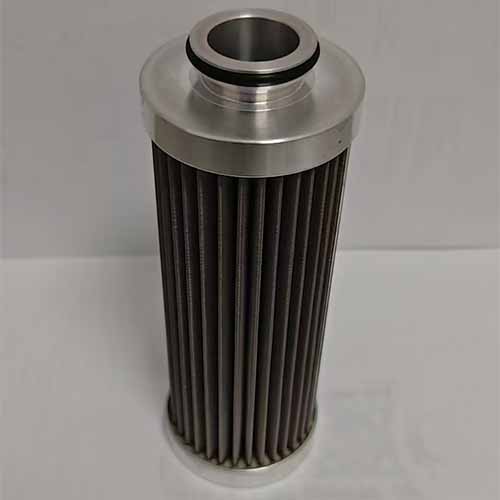
A surface filter removes contaminants primarily on the outer surface of the filter media.
Instead of allowing particles to penetrate into the media, the filter acts like a screen. Particles larger than the openings are retained on the surface while the fluid continues to flow through.
Common surface filter materials include:
Wire cloth
Perforated screens
Reusable metal filter elements
Because contaminants accumulate on the surface, these filters are often easier to inspect, clean, and backflush.
Typical applications include:
Suction strainers
Pipeline protection
Coarse filtration
Reusable filtration systems
Pre-filtration stages
Surface filters are particularly effective for removing larger particles and protecting downstream equipment from debris.
Depth Filter vs Surface Filter — What's the Difference?
Although both technologies remove contaminants from oil, they do so in very different ways.
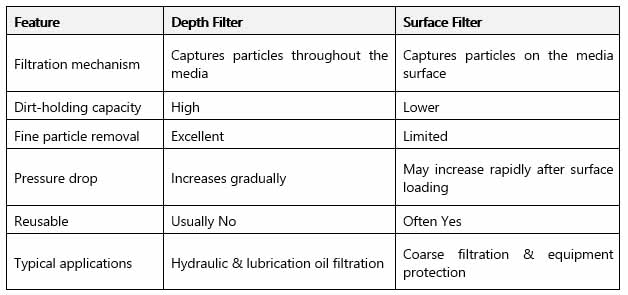
The most important takeaway is this:
Neither technology is inherently better. The right choice depends on your contamination level, maintenance strategy, and system requirements.
For example, a hydraulic system with servo valves may require high-efficiency depth filtration to maintain strict cleanliness levels, while a pipeline strainer protecting a pump inlet may only need a reusable surface filter to stop larger debris.
Which Filtration Technology Fits Your Application?
The best filtration solution starts with understanding your application rather than comparing products.
Choose a Depth Filter if:
A depth filter is generally the better choice when:
Fine particle removal is required.
Achieving a lower ISO 4406 cleanliness code is a priority.
Extending oil life is an important objective.
Protecting precision components such as servo valves and proportional valves is critical.
An offline oil filtration system is being used.
Long service intervals and high dirt-holding capacity are desired.
Depth filtration is commonly found in industrial hydraulic systems, turbine lubrication systems, and continuous oil conditioning equipment.
Choose a Surface Filter if:
A surface filter may be more suitable when:
The primary goal is removing larger contaminants.
The filter element needs to be cleaned and reused.
The filter is used as a protective strainer.
Frequent maintenance is acceptable.
Coarse filtration is sufficient for the application.
Surface filtration is often used as the first stage of protection where preventing large particles from entering pumps or downstream equipment is the main concern.
Choosing the Right Filter for Hydraulic and Lubrication Systems
Selecting the right filtration technology involves more than simply comparing filter types.
Before choosing a filter, consider several important factors:
Required ISO 4406 cleanliness level
Particle size distribution
Oil viscosity
System flow rate
Allowable differential pressure
Maintenance interval
Equipment criticality
Overall operating cost
A filtration solution should always support the reliability objectives of the entire system rather than focusing solely on filter efficiency.
It's also worth remembering that filter media selection is just as important as filtration technology. Cellulose, glass fiber, and other media each have different performance characteristics that influence filtration efficiency, dirt-holding capacity, and service life.
Selecting between a depth filter and a surface filter isn't about finding the "better" technology—it's about choosing the one that best matches your operating conditions and contamination control objectives.
If you have questions about oil filtration or selecting the right filter solution for your hydraulic or lubrication system, feel free to contact the FiltraMate team. We're always happy to discuss filtration challenges and share practical solutions.