
Hydraulic Filter Selection: Finding the Right Balance Between Oil Cleanliness and Cost
Selecting the right hydraulic filter isn't simply about choosing the finest micron rating available. In fact, excessive filtration can be just as costly as insufficient filtration.
Think of a hydraulic filtration system as the immune system of your hydraulic equipment.
If the immune system is overly sensitive, it reacts to every tiny particle, consuming unnecessary energy and creating new problems. If it is too weak, harmful contaminants freely enter the body and eventually cause illness.
Hydraulic filtration works in exactly the same way.
A well-designed hydraulic filtration system should protect critical components from contamination while maintaining reasonable operating costs. Choosing the right hydraulic filter element is therefore about finding the optimal balance between oil cleanliness, equipment reliability, and cost efficiency.
Why Choosing the Finest Filter Isn't Always the Best Solution
Many engineers assume that finer filtration automatically means better protection.
While this may sound reasonable, selecting an unnecessarily fine hydraulic filter element can actually reduce system efficiency and increase maintenance costs.
Higher Operating Costs
As filtration efficiency increases, filter media become more sophisticated and manufacturing costs rise accordingly.
At the same time, finer filters generally have lower dirt-holding capacity. They reach their differential pressure limit more quickly, requiring more frequent filter replacement and increasing maintenance expenses.
Higher filtration efficiency also creates greater flow resistance. The hydraulic pump must consume more energy to overcome the additional pressure drop, and that extra energy is ultimately converted into heat.
In many applications, this additional cost provides little or no practical benefit.
Increased Risk of Unexpected Downtime
Ultra-fine filters can clog much faster in contaminated environments.
When differential pressure rises beyond the allowable limit, the filter clogging indicator may activate, or the bypass valve may open to maintain oil flow. Once bypass occurs, the system temporarily loses filtration protection.
Frequent filter replacement also increases maintenance activities, creating more opportunities for installation errors, incorrect filter selection, or contamination during servicing.
The common misconception is believing that the cleanest oil possible is always the best solution. In reality, the objective is to achieve the required cleanliness level, not the maximum filtration efficiency regardless of cost.
The Hidden Cost of Insufficient Filtration
Choosing a filter that is too coarse can be even more damaging.
Industry studies consistently show that contamination is responsible for more than 80% of hydraulic system failures.
Once contamination enters the hydraulic system, equipment deterioration usually follows three stages.
Stage One: Accelerated Wear
Particles larger than the clearance between moving components behave like abrasive sandpaper.
Each scratch generates additional wear particles, creating a self-accelerating cycle of contamination and component wear.
Stage Two: Performance Degradation
Contaminants become trapped between valve spools and valve bodies, causing sticking, sluggish response, increased internal leakage, and unstable system performance.
Small control orifices and damping holes may also become partially blocked, reducing pressure and flow accuracy.
Stage Three: Component Failure
Precision components such as piston pumps, servo valves, and proportional valves are especially vulnerable to contamination.
Once their precision surfaces are damaged, repair costs increase significantly, and unexpected downtime often follows.
Four Factors That Determine the Right Hydraulic Filter
The best hydraulic filter selection is always application-specific.
Rather than choosing filters based only on micron ratings, engineers should evaluate four key factors.
1. Component Sensitivity
The most contamination-sensitive component should determine the filtration requirement for the entire hydraulic system.
Typical recommendations include:
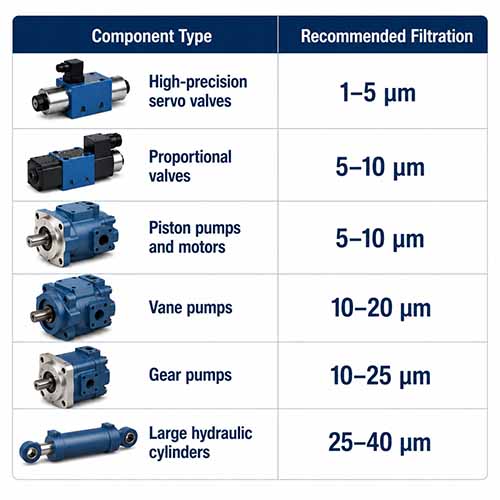
The more precise the component, the cleaner the oil must be.
2. Operating Pressure
System pressure has a direct influence on contamination damage.
Under high pressure, even microscopic particles can become embedded into metal surfaces, accelerating wear.
As a general guideline:
High-pressure systems (>21 MPa) typically require finer filtration (5–10 μm).
Medium- and low-pressure systems often achieve an excellent balance with filtration ratings between 10–25 μm.
3. Filter Location Within the Hydraulic System
Not every filter performs the same function.
A complete hydraulic filtration system typically includes several filters with different objectives.
Pressure Line Filters
Installed downstream of the pump, these filters protect the most sensitive components and usually require the highest filtration efficiency.
Return Line Filters
Return filters capture wear particles generated inside the hydraulic system before the oil returns to the reservoir.
Because they process the full return flow, they should combine good filtration efficiency with high dirt-holding capacity.
Suction Filters
Installed at the pump inlet, suction filters provide coarse filtration to prevent large contaminants from entering the pump.
Their priority is maintaining unrestricted oil flow to prevent pump cavitation.
For more information about difference between Pressure line filters, Return line filters, suction filters, please read follow articles.
Pressure-Line Filter vs Return-Line Filter: What's the Difference?
Suction Filter vs Return Filter in Hydraulics: Key Differences Explained
Offline (Kidney-Loop) Filters
Offline filtration continuously cleans hydraulic oil independently of machine operation.
Since only a portion of the oil flow passes through the filter at any time, extremely fine filter elements can be used to gradually improve ISO 4406 oil cleanliness levels.
4. Don't Judge Filters by Micron Rating Alone—Use Beta Ratios
Modern hydraulic filter elements are evaluated according to ISO 16889, which measures filtration performance using the Beta Ratio (β).
The Beta Ratio is defined as:
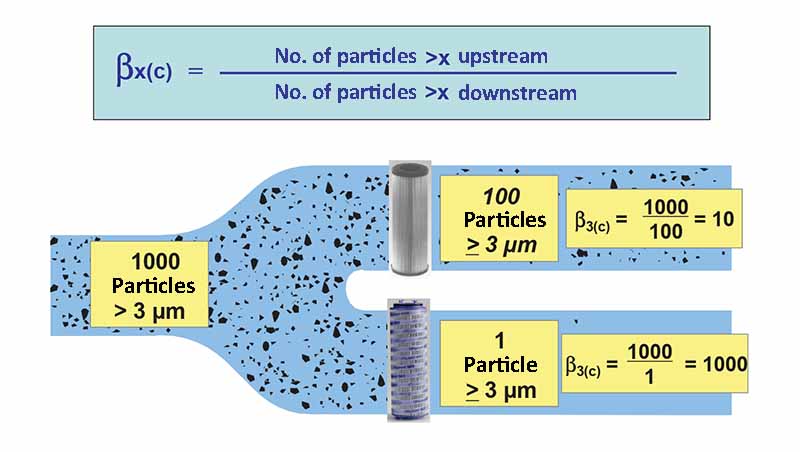
A higher Beta Ratio indicates higher filtration efficiency.
Filtration efficiency can be calculated as:
η = (1 − 1/β) × 100%
For example:
β₁₀ ≥ 200 means the filter removes 99.5% of particles 10 μm and larger.
This is far more meaningful than simply stating a nominal micron rating.
When comparing hydraulic filter elements, engineers should evaluate both the micron rating and the Beta Ratio to ensure the filter delivers the required level of contamination control.
A Practical Strategy for Hydraulic Filter Selection
A practical hydraulic filtration strategy follows a logical sequence.
First, identify the most contamination-sensitive component in the system.
Next, review the manufacturer's recommended cleanliness level or filtration requirement.
Then consider operating pressure, contamination exposure, maintenance intervals, and operating costs.
Finally, assign different filtration ratings to different filter locations according to their specific functions.
For mission-critical equipment with high downtime costs, selecting a slightly finer filtration level may provide valuable additional protection.
For less demanding applications, meeting the required cleanliness target with a cost-effective filter often delivers the best long-term value.
The goal is not to install the finest filter everywhere, but to apply the right filtration strategy in the right location.
The Best Hydraulic Filtration Strategy Is About Balance
The goal of hydraulic filtration is not to achieve the finest possible filtration at any cost, nor is it to settle for the lowest-cost filter available.
Instead, successful hydraulic filter selection is about balancing oil cleanliness, system reliability, maintenance costs, and component protection.
A properly designed hydraulic filtration system continuously controls contamination below the tolerance level of the most sensitive components. When the right hydraulic filter elements are selected for each filter location, your equipment operates more reliably, maintenance intervals become longer, and the total cost of ownership is significantly reduced.
Ultimately, the best hydraulic filtration system is one that delivers the right level of cleanliness at the right cost.
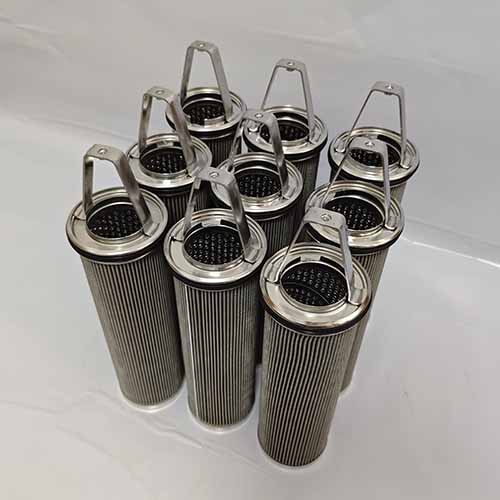
Need Help Selecting the Right Hydraulic Filter?
Whether you're looking for replacement hydraulic filter elements for leading brands or need technical advice on hydraulic oil filtration, oil cleanliness, or contamination control, the FiltraMate team is here to help.
With years of experience supplying high-quality replacement hydraulic filter elements for industrial applications, we help distributors, maintenance companies, and equipment users improve system reliability while reducing operating costs.
If you have questions about hydraulic filtration or need an alternative hydraulic filter element, feel free to connect with FiltraMate. We'd be happy to discuss your application.