
Suction Filter vs Return Filter in Hydraulics: Key Differences Explained
In hydraulic systems, hydraulic filters play a critical role in contamination control and equipment protection. They remove harmful particles from hydraulic oil, helping prevent wear, system failure, and costly downtime.
However, many people still misunderstand the difference between suction filters and return filters, and some even assume they can be used interchangeably.
In reality, these two hydraulic filter types differ significantly in:
Installation position
Filtration precision
Working pressure
System function
Understanding these differences is essential for selecting the right hydraulic filtration solution and extending hydraulic system life.
What Is a Suction Filter?
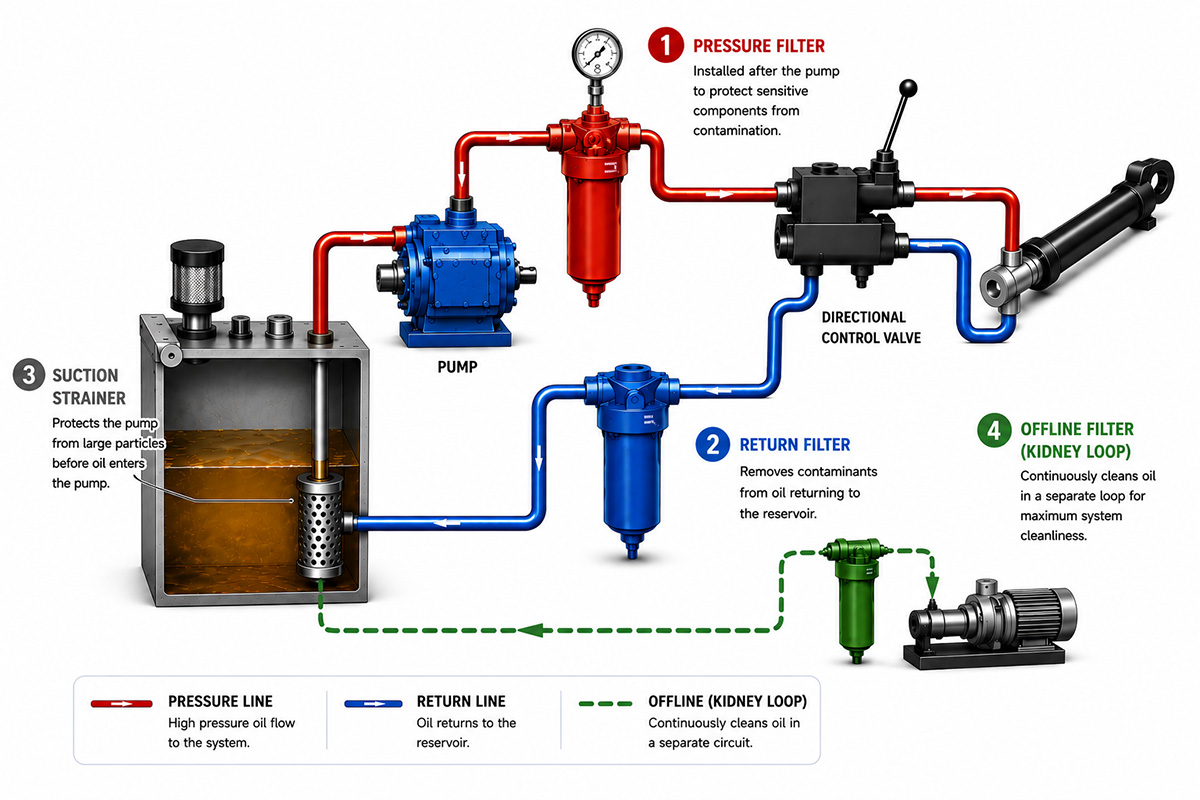
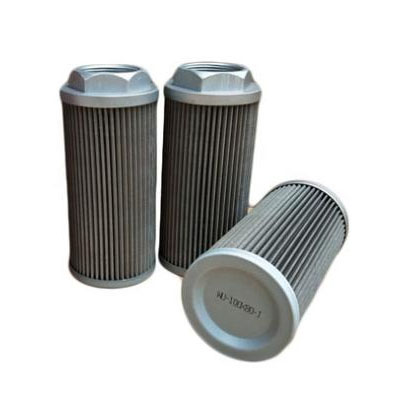
A suction filter (also called a suction strainer or suction line filter) is typically installed at the inlet of the hydraulic pump.
Its main function is to filter hydraulic oil coming from the reservoir and prevent large contaminants from entering the pump.
👉 The primary goal of a suction filter is to protect the hydraulic pump from contamination-related wear or damage.
Key Features of Suction Filters
✔ Low Filtration Precision
Suction filters usually provide coarse filtration:
👉 Typically 30–100 microns
This helps minimize flow resistance and reduce cavitation risk.
✔ High Structural Strength
Because suction filters operate under negative pressure conditions, they must withstand pump suction forces without collapsing or deforming.
✔ Installed Inside or Near the Reservoir
Most suction filters are submerged in the hydraulic tank to ensure stable oil flow into the pump.
What Is a Return Filter?
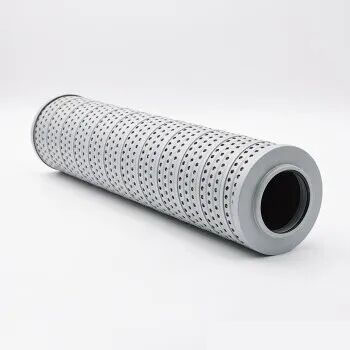
A return filter (return line filter) is installed in the hydraulic return line before oil flows back into the reservoir.
Its purpose is to remove contaminants generated during system operation, including wear particles from:
Hydraulic cylinders
Hydraulic motors
Valves
Pumps
👉 Return filters help maintain overall hydraulic oil cleanliness and contamination control.
Key Features of Return Filters
✔ Higher Filtration Precision
Return filters typically provide finer filtration:
👉 Usually 10–25 microns
This allows them to effectively capture fine contamination particles.
✔ Lower Working Pressure
Since return lines usually operate under lower pressure conditions, return filters generally experience less mechanical stress.
✔ Equipped with Bypass Valves
Many return filters include bypass valves to maintain oil flow if the filter becomes clogged, preventing excessive back pressure in the hydraulic system.
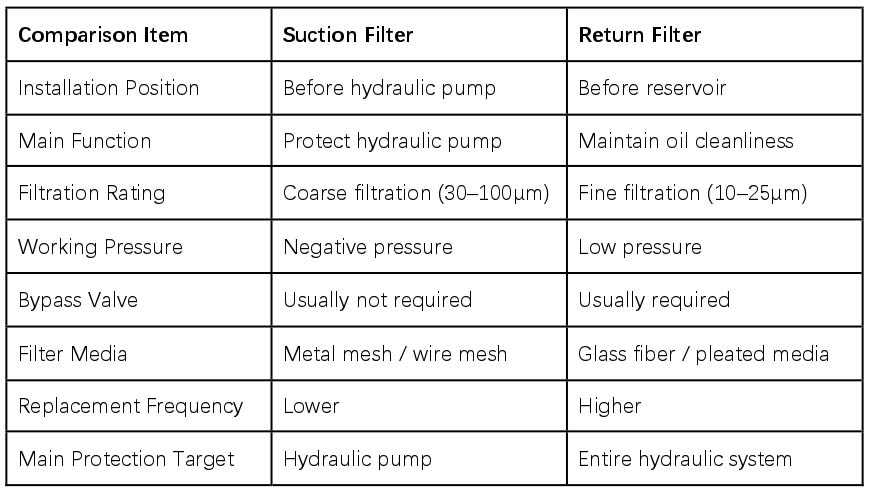
Key Differences Between Suction Filters and Return Filters
✔ Different Installation Positions
Suction filters are installed before the hydraulic pump.
Return filters are installed before oil returns to the reservoir.
Their installation position determines their filtration purpose and operating conditions.
✔ Different Functions
Suction Filters
Designed specifically to protect the hydraulic pump by preventing large contaminants from entering the pump.
Return Filters
Designed to control hydraulic oil contamination levels and maintain long-term oil cleanliness throughout the system.
✔ Different Filtration Ratings
Because they serve different purposes, their filtration precision also differs.
Suction filters: typically 50–180 microns (coarse filtration)
Return filters: usually below 20 microns (fine filtration)
✔ Different Filter Element Structures
Suction Filters
Commonly use:
Metal mesh filter elements
Wire mesh or wire-gap structures
These designs minimize pressure drop and maintain smooth oil flow.
Return Filters
Typically use:
Pleated glass fiber media
High-efficiency synthetic fiber media
to achieve better filtration efficiency and higher dirt holding capacity.
✔ Different Pressure Drop Requirements
Suction Filters
Because they are affected by pump suction characteristics, pressure drop requirements are extremely strict:
Initial pressure drop ≤ 0.003 MPa
Maximum pressure drop ≤ 0.02 MPa
Excessive restriction may lead to:
Cavitation
Pump starvation
Noise and vibration
Return Filters
Return filters can tolerate higher differential pressure:
Maximum differential pressure: typically 0.2–0.35 MPa
Working pressure: generally below 1 MPa
✔ Different Flow Selection Principles
Suction Filters
Usually selected according to the pump’s maximum flow rate, using a safety factor of 1.5–2× the actual operating flow.
👉 Selection should be based on actual flow capacity rather than nominal flow rating.
Return Filters
Selected according to the system’s peak return flow, especially in applications with:
Differential cylinders
Return flow surges
Variable operating conditions
Typically using a safety factor of 2–4×.
If you want to know the difference between pressure line filters and return line filters, please check this aricle. Pressure-Line Filter vs Return-Line Filter: What’s the Difference?
Best Practices for Hydraulic Filtration
✔ Use Multi-Stage Filtration
Critical hydraulic systems should combine:
Suction filters
Return filters
Pressure-line filters
for better contamination control and system protection.
✔ Monitor Oil Cleanliness Regularly
Routine oil analysis helps determine:
Filter condition
Oil contamination level
Proper maintenance intervals
✔ Choose High-Quality Hydraulic Filters
Low-quality hydraulic filters may lead to:
Filter collapse
Poor filtration efficiency
Hydraulic system contamination
Reliable OEM replacement hydraulic filters are essential for stable hydraulic system operation.
At FiltraMate, we provide:
Suction filter elements
Return line filter elements
Pressure-line filter elements
OEM replacement hydraulic filters
Hydraulic oil filtration solutions
Technical support for hydraulic filtration systems
Helping customers improve:
✔ Hydraulic system reliability ✔ Oil cleanliness ✔ Equipment life ✔ Maintenance efficiency
across a wide range of industrial hydraulic applications.